

1. Resistance Build up
When the crusades first started, individual Muslim generals took up arms against them. Kerbogha, Jikirmish, Jawali Saqawa, Najm ad-Deen Ilghazi, Aqsunqur al-Bursuqi and others challenged the crusaders in limited ways. Mawdood ibn at-Tuntash forced the crusaders into defensive positions before he was assassinated.
All these roles were gradual and complementary and laid the foundation for Salahuddeen.
Work in your limited capacity to build a better world. Every effort will count towards the global upliftment of humanity.
2. Islam above Ethnicity
The heroes against the crusades came from various ethnicities, united by their Islamic faith.
The leaders who fought against the Crusades in the Middle East were primarily from the Seljuk Turk, Kurdish, and Arab populations. The Mamluk Sultans who led the final campaigns to expel the remaining Crusaders in the late 13th century were originally slaves who rose to lead the Muslim world.
Some of the greatest scholars and heroes of Islam were not Arab. Race and social standing are no barriers to attaining success in Islam.
3. Scholars and Revival
Imam Ghazali’s works aimed to reform society. Nizam al-Mulk established the Nizamiyya schools to train scholars, judges, and officials who were influenced by the teachings of Imam Ghazali. They in turn educated rulers like Nuruddeen and Salahuddeen. Sheikh Abdul Qadir Gilani was perhaps the most influential scholar in Salahuddeen’s era.
The rise of Salahuddeen was not a sudden event, but the culmination of a Sunni revival that re-educated Muslims and prioritized unity and Jihad.
The starting point of any significant revival in Islam is driven by scholars who reconnect the masses with the demands of Islam.

Highlight 1. Aleppo and its Citadel
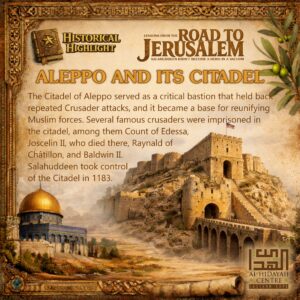
The city of Aleppo and its Citadel served as a bastion against crusader attacks. Muslim leaders like Salahuddeen used it as a base to launch crucial assaults on the crusaders.
Several famous crusaders were imprisoned there.
4. Victory and Setbacks
Disunity among the Sunni states and the threat of the secretive Hashashin group made progress agonizingly slow. Added to this was the Shia treachery in reaching out to the Crusaders. Military leaders like Mawdood who began to gain victories were killed and Muslim forces suffered defeats on the battlefield.
These setbacks were viewed as a means of separating the sincere from the hypocrites. Lessons were learnt from the failures and reforms were made.
5. Assassin’s Subterfuge
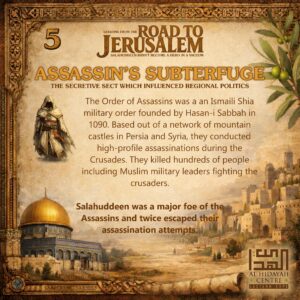
The Order of Assassins was an Ismaili Shia military order founded by Hasan-i Sabbah in 1090. Based out of a network of mountain castles in Persia and Syria, they conducted high-profile assassinations during the Crusades. They killed hundreds of people including Muslim military leaders fighting the crusaders.
Salahuddeen was a major foe of the Assassins and twice escaped their assassination attempts.
Highlight 2. Nuruddeen’s Mimbar
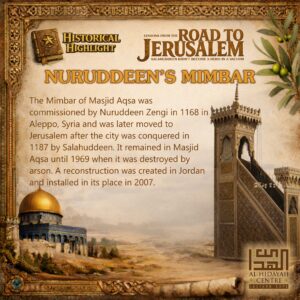
The Mimbar of Masjid Aqsa was commissioned by Nuruddeen Zengi in 1168 in Aleppo, Syria and was later moved to Jerusalem after the city was conquered in 1187 by Salahuddeen. It remained in Masjid Aqsa until 1969 when it was destroyed by arson. A reconstruction was created in Jordan and installed in its place in 2007.
6. The Young Boy Chemist
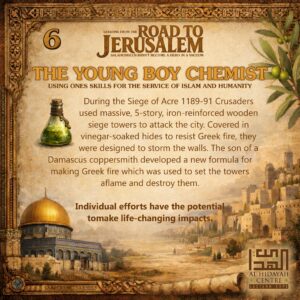
During the Siege of Acre 1189-91 Crusaders used massive, 5-story, iron-reinforced wooden siege towers to attack the city. Covered in vinegar-soaked hides to resist Greek fire, they were designed to storm the walls.
The son of a Damascus coppersmith developed a new formula for making Greek fire which was used to set the towers aflame and destroy them.
Individual efforts have the potential to make life-changing impacts.
7. Psychological Warfare
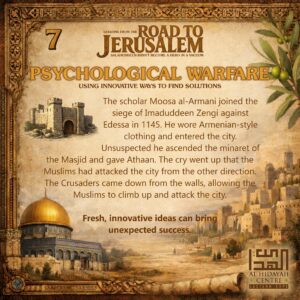
The scholar Moosa al-Armani joined the siege of Imaduddeen Zengi against Edessa in 1145. He wore Armenian-style clothing and entered the city. Unsuspected, he ascended the minaret of the Masjid and gave Athaan. The cry went up that the Muslims had attacked the city from the undefended side. The Crusaders came down from the walls, allowing the Muslims to climb up and attack the city.
Fresh, innovative ideas can bring unexpected success.

8. Muslims Disunited
The Muslim Emirate of Damascus allied with the Christian Kingdom of Jerusalem against Nuruddeen. Ridwan, Emir of Aleppo, fought against his brother the Emir of Damascus. This rivalry continued even after the arrival of the crusaders. Ridwan allied with the crusader Tancred of Antioch, against the emir of Mosul, Jawali Saqawa.
Ridwan was surrounded by and favoured the Ismaili Shias. He was a patron of the Shia Assassins, giving them freedom to practice and propagate their religion by letting them establish a mission house in Aleppo and use the city as a base.
Disunity and infighting over power bases sapped the strength of the Muslims in the face of external threats.
9. Educational System
Salahuddeen established educational and academic institutes to promote the beliefs of Ahlus Sunnah and eradicate the Shia influence. All prominent figures in his state and family, men and women, also established schools. Many of the schools would have endowments for the teachers and students including baths, hospitals and stipends.
The battle to win hearts and minds saw Shiasm eradicated from Egypt and a revival of Islam in Muslim lands.